Writing Workshop: Making Senses

A while back, I promised to start regular little conversations with you guys here on my site, but then, what with world pandemics, deaths in the family, fire falling from the sky, and plagues of locusts, 2020 got, well…rather busy. For all of us, I imagine.
Things fall a little by the wayside when you’re busy bleaching your house daily, inexpertly thrown into the role of home-schooling kids, and trying desperately to find ten minutes of free quiet time a day to work on the book that people keep sending you insistent messages about on social media, all while mentally processing the apocalypse. We’ve all been spinning a lot of plates, haven’t we? (and dropping a few, in my case).
But…here we are. It’s September, autumn leaves are turning, I’m spending a lot more time in the writing office, and while we are still far from dry land, my particular seas have calmed somewhat, and I finally find myself with more drive, focus and time to spend on the things I love. So, I thought I’d dip into some writing talk. I put out feelers a while back on my Instagram and Twitter to see what kind of topics people would be interested in reading about, and one thing that came up time and again was ‘writing advice and writing tips’.
Before I share my thoughts, I will say this.
I hate writing advice.
I don’t like taking it from others. I have a stubborn knee-jerk reaction when I am told ‘this is the way X should be done’ and I invariably roll my eyes when I scroll past an article or tweet which declares with unshakable authority ‘Ten things you NEED to have in your opening chapter!’ or ‘The most common mistakes you are making and how to fix them.’
Just no. Silence, random stranger.
In my defence, this is not because I feel I need no advice from anyone else, or that there is literally no longer a solitary inch of room for improvement in the magnificence of me, it is simply because I suffer from a debilitating and incurable medical condition known as ‘Contrary Asshat Syndrome’. I am well aware that water extinguishes fire, but were I to suddenly and unfortunately set alight, and some random stranger told me ‘you need to get some water on that, you do mate.’ I would stubbornly burn to death rather than be told what I should or shouldn’t do, leaving behind nothing but a charred skeleton raising a middle finger like a blackened smoking match in defiance of this well-meaning good Samaritan.
I hope you’re a better person than me. If you hate advice, you’re probably not reading this in the first place anyway.
I believe writing is an intensely personal experience, and that everything a person writes is, and should be, coloured by their own experiences and their own personality, outlook, beliefs and style (hopefully). So…while admittedly there are some fairly obvious basic rules that are universal: ‘Learn your ‘they’re/their/there’ and don’t write ‘should of’, these are so basic, that it’s fairly insulting to assume that anyone serious enough to want to sit and commit themselves to writing a novel has not already progressed past Level One of ‘mastering your own damned language’.
They’re what I call the ‘so obvious they don’t need talking about’ rules. So, let’s not.
Most other ‘rules’ (I’m looking at you, universal foam-at-the-mouth hatred of the demonic adverb, but not you alone) are subjective. For every hundred articles telling you something is a ‘definite no-no’ or an ‘absolute must-do’, there are a hundred successful books out there whose authors completely ignored the holy guidebook and instead did whatever the hell they wanted to anyway.
Indeed, some of the most successful or interesting books I’ve read are the ones that break or bend any accepted ‘golden rules’ and they stand out from the crowd precisely because of them.
But still… don’t write ‘should of’…really.
I mean it.
Therefore, in consideration of the above, patient reader, my own particular approach to bringing you writing advice is not going to be couched as instructional. It’s not ‘what you should do’, or indeed ‘what will work for you’. It’s simply ‘what I do’. Because what I do works for me. And that’s all I know to tell you. I can’t tell you how anyone else writes except for me.
The more you write, and the longer you’re a writer for, I find that’s it’s not the case that you get to know more about the skills of writing, but more that you get to know more about your particular skills of writing (and your weaknesses too). People will loftily tell you (often at dinner parties and completely unrequested and unprompted) that writing is an Art, with a capital A. That it’s in the blood and cannot be denied, and that the astonishing magical power to spin thoughts and ideas into stories on paper, as though spinning straw into gold, is passed down from on high above in a ray of light accompanied by an angelic choir. Nonsense. While I wholeheartedly agree that writers do of course need to have that intrinsic spark of inspiration, that hunger to tell tales above all else, regardless of if anyone is listening, it is also, very much….very very much…a craft. And crafts need to be worked on, learned, improved and honed.
Your closest friend might be passionate about woodcarving, it might consume their every thought with inspiration, but if that friend doesn’t practise hard, and hack away at a heck of a lot of wood, you still might find yourself with a Christmas gift of a damn-ugly, crazily whittled and wobbly three-legged stool that nobody wants. It is in the sawdust, swearing and splinters, that the carpenter hones his craft, and the same goes for writing. Blood, sweat and ink. Because we’re not perfect, and we are always learning.
So, here are a series of blogspots about writing. They’re my chairs. I carved them to my tastes. I find them comfortable, and when I sit on them, I don’t wobble, but I can’t guarantee your ass will fit in them as comfortably as mine does, or that you won’t turn around and declare that ‘actually, I prefer mine with wheels’ or abandon my seating altogether for your own zebra-striped loveseat. Either is fine. There’s plenty of room to sit in the writing world after all, but if you want to sit by me, pull up a wobbly three-legged stool and let’s cover our first topic: Making Sense.
One of the most immersive things that I’ve discovered in writing, is the ability of a good writer to pull you into a scene, long before there is witty dialogue, way before there is breakneck action, simply by picking you up under the arms and carrying you like a helpless child, dumping you with parental confidence and authority right in the middle of where your characters are. This is well done when descriptions engage the senses.

A common idea when thinking how to describe a location or a scene, is to visualise it as a movie in your little writer’s head. You hear this all the time. ‘My stories play out cinematically, and then I just have to get them down on the page’. Now, while I am a HUGE fan of cinema and movies (storytelling in another form, of equal value, and one I could happily write a whole other blog series about), there’s a solid reason why reading versus viewing is almost always considered more intimate, more personal. Cinema, at best, engages chiefly only two senses. Sight and sound.
A lot of bad descriptions in books follow this cinematic format (which works on screen but not as well on paper) or even worse, they rely mainly on sight alone. The writer is so eager for the reader to visualise the place they are writing about, they are enthusiastic to describe it to them, to set out a picture in the readers mind of how things look, and that’s all they do.
Take this brief example:
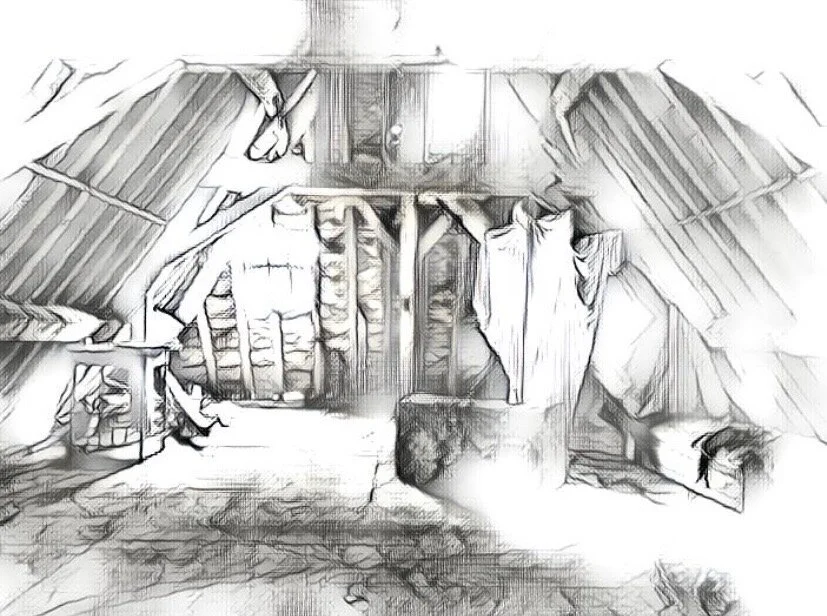
“He walked into the attic room. It was large and shadowy, bare boards underfoot and dusty beams criss-crossing the peaked ceiling. At the far end was a large rose window, through which the yellow autumn light spilled, painting stripes on the floorboards. Boxes were piled everywhere, and in one corner, a dusty old rocking horse, it’s once-bright carnival paint now faded and chipped. He ran his hand across the nearest dusty box.”
It’s…serviceable. There’s nothing actually wrong with the description. It does exactly what it’s supposed to. It lets the reader know what the attic looks like, what the character sees. But that’s all it does. It feels flat, thin, like a sketch with no depth. We are visualising what the writer wants us to see, but with a little more effort, we could be so much more immersed.
We have five major senses (for the sake of argument I’m not going to get into quibbles about the other, less common senses such as ‘sense of danger’ ‘sense of humour’ ‘common sense’ or ‘fashion sense’. Let’s stick to the ones we learned in school. Sight, hearing, touch, taste, smell.
By using more writing tools in our arsenal, we can stick a few more hooks in the reader, pulling them much deeper into the scene. Here’s a (less than perfect) example of what I mean, amending and expanding the merely visual description to attempt to appeal instead to all of the reader’s senses:
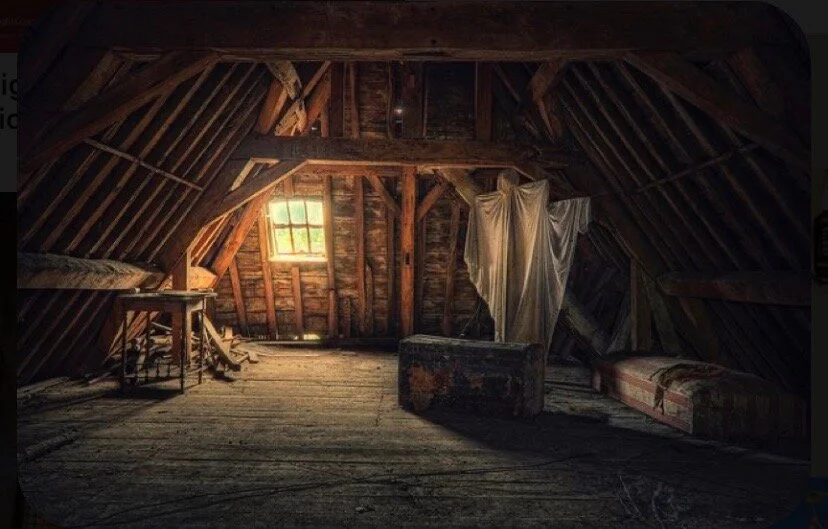
‘He walked into the attic room, rough bare boards creaking beneath his feet as he passed through the shadows. In the muffled, dusty silence, laying heavy about his shoulders, even the quiet noise of his approach seemed intrusive and harsh, and unconsciously he quietened his step, treading lightly, as though trespassing. The round, cloying smell of sawdust filled his nose as he glanced up, blinking, at the shadowy wooden beams criss-crossing the roof-space. High up there, dust motes danced in the air between the bars of wood, caught in warm strips of sunlight; glimpsed ghosts shimmering in the silence. At the far end of the long room, a rose window, panes fogged with age and condensation, glowed. Its smeared and unclean panes diffusing the bright sunlight outside and filtering it softly and quietly into the room.
He swallowed, mouth dry, glancing around at the many cardboard boxes piled here and there with seeming abandon. Somewhere beneath the fresh-wood smell, a lingering hint of damp cut through the air, a sour note where the aged boxes sagged.
Advancing cautiously through the stillness, the air of this long-closed room felt dead and dry against his skin, and he ran a hand across a nearby box, leaving trails in the thick dust, smudging his fingers with itchy motes. A long-abandoned rocking horse, propped against a sloping wall, seemed to watch his progress with frozen interest. Its bright carnival colours long since faded and chipped, one wild black eye unblinking as it tracked his progress from the shadows.’
This addition of other senses than merely sight give us much more descriptive fuel and tell us a lot more about our example protagonist’s experience in the attic. Whereas the first extract reads like a realtor’s room description, descriptive but not emotive, the second tells us not only what he sees, but what he smells, hears, feels, etc.
Another change I’ve made here, if you noticed, is to place the reader not only in the room with the protagonist, but in the head of the protagonist. We are told not just what he hears (the floorboards creaking under his feet) but how this affects his feelings (making him feel like an intruder). We also move the ‘camera’s perspective’ from a passive third person, to within the protagonist’s headspace. Instead of just mentioning that there are roof beams, we see them through his eyes as he ‘glances up’ at them. We follow with him as he ‘advances cautiously’ through the room.
It’s by no means award-winning prose, but it’s a fair example of how you can begin to add layers of atmosphere and meaning to what was simply the bare sketch of a description.
Another element I attempt to bring in with this second example is beginning to hint at tone (in this case a mild apprehension, which may well lead to full blown spookiness with a little more work). Allowing your description, through the character, to use little bursts of metaphor or simile to suggest mindset can be more effective than a hundred info-dump descriptions. The dust motes he sees moving in the air could just as easily have been likened to fairies as they are to ghosts, which would give a very different tonal feel in the scene. The job of the writer is to steer the readers’ expectations, and an easy way to do this is through persuasive imagery. As well as the suggestion of ‘ghosts’ in the dust motes, here we also have a lingering note of damp hiding beneath the freshness of the sawdust, which to me seems quietly menacing, something unpleasant hidden away under a veneer of normalcy. It subtly suggests rot and decay, and the promise of corruption of one kind and another. The cardboard boxes themselves are described as aged and sagging, which has basic corpselike connotations. And the description of the rocking horse in the corner has been embellished in revision to imbue it (in the mind of the protagonist at least) with a rather malevolent watchfulness.
I’m going to keep this example of the attic for my next blog post, in which I’m hoping to elaborate more on setting expectation for tone, atmosphere and mood, using metaphor and simile in different ways to explain how to bring a house to life (or at least how I would bring a house to life). Mild personification in inanimate description goes a long way, and metaphor is more immediate and powerful than simile - but these are things to cover next time.
So, for now, if you want a simple exercise to flex your own immersive full-senses in writing, try this:
Choose a simple setting. Could be a motel room, could be a forest clearing, could be a train carriage…up to you. Write a basic description, as in the first example of the attic. Describe the place visually, but don’t elaborate, just tell yourself what your scene looks like, nothing more.
Then next, write a couple of different versions of this same excerpt, engaging as many senses as you can, and in different ways. Write one version where your scene is described in a beautiful, peaceful or uplifting way. Then a version where your scene is described in a haunting, creepy or menacing way, and lastly a version where it is described in a sad, mournful or bittersweet way.
Compare the three and notice how you have chosen which senses to describe and engage for different effects. (This might also tell you what kind of things you tend to find scary, or beautiful, or sad – it’s always surprising what you can learn about yourself while writing.)
The main rule is, you must only describe the same place. No adding in extra signifiers of mood. It’s cheating if you suddenly drop a creepy jack in the box into your scene, or there’s a previously unmentioned unicorn suddenly frolicking in the background. What you are aiming to do is to drop your reader into the scene using every sense they have, and once immersed, to direct their experience of it using only description of the existing environment.
I’ve always found this to be a fun little exercise, and it helps build up your own writing chops, and hone your control of the scene. Perfect and practise your whittling skills.
As I’ve stated throughout. This is simply what works for me. I believe it’s a transferrable method for anyone, but I’m not preaching. If you’re finding my chairs wobbly, shuffle over to your own comfortable sofa and we can still enjoy writing together.
I hope you’ve found this interesting, or that it’s at least given you an idea of the kind of things I personally enjoy / don’t enjoy about descriptive writing. Other things I’m going to be looking at in the future are ‘less is more…except when it isn’t’, ‘metaphor vs simile, and when I like to use which’, and ‘For the love of all that’s holy, show don’t tell…unless you have to tell’.
If there’s any aspect of writing, or the writer’s life, either behind or indeed beyond the trusty laptop, that you’d be interested in hearing me waffle about in one of these posts, then by all means drop me a comment here, or a DM over on Twitter or Insta. I’m always happy to chew the trade fat with others.
Now, I’m off to bleach my house and home-school some more kids before I get on with the next chapter of my WIP.