When less is more: the Kondo description method

The is the second of my blog posts about writing. If you missed the first, just know that I’m not angry…I’m just disappointed. Feel free to go back and read that one first, and we’ll say no more about it. You don’t need to lose your Netflix privileges. We don’t need three minutes on the naughty step. Just have a three-hundred-word essay on my desk by morning explaining in detail your overwhelming feelings of remorse and I promise not to bad-mouth you as a sloppy student to the rest of the faculty while we’re having tea in the staff room and comparing elbow patches.
Now that we’re past that unpleasantness, just to recap, what I’m doing in these little blogs (indeed some of them will be small enough to be referred to as Bloglettes - no, you can’t steal that term, I just copyrighted it), is talking a little bit about my views on the craft of writing, and different things I’ve found useful on my own journey as an author.
I stated in my last post when we touched on sensory writing, and I’ll repeat it again now, that this is only what I’ve observed on my own writing odyssey; things that I know, through trial and error, work well for me. They might not work for you. You might in fact violently disagree with my views and be so horribly against them, that you demand to meet me on the misty heath at dawn to settle our differences with pistols.
That’s fine. I’ll set down my cup of tea and polish my elbow patches. To be fair, a duel to the death is probably the most fun activity two people can have right now with the social distancing guidelines anyway.
So if anything, think of my writing thoughts simply as nibbles at one of those parties you’ve been forced to go to (you know the kind, where you only know that one friend and they immediately abandon you as soon as you get there, leaving you in a room full of strangers and almost inevitably resulting in you talking to the cat in the kitchen simply for something to do.) You can help yourself to my nibbles, but if you don’t like them, I don’t mind. They won’t go to waste. I’ll eat them when you’ve all gone home.
The writing subject, or technique, that I wanted to touch on today is what I term the ‘Kondo factor’. Less being more.
Describing things to death and turning your readers’ happy train journey into a stalled adventure, or at worst, a derailed wreck.

I see in a lot of writers who are just starting out (and I see it in a lot of my own old writing from when I was a teenager and starting out, scrawling out massive stories of my own) a tendency to absolutely drown the reader in information, both descriptive (of a scene, a location, a place) but also around dialogue. I’m going to touch on both of these separately in different posts. The principles of ‘too much’ in descriptive writing and ‘too much’ in dialogue are largely overlapping, but I want to tackle them separately, because frankly, it’s my party and I don’t like my nibbles to mix in the bowl (no-one like kettle chips that are uncomfortably close to the olives, right?).
Describing things is pretty much the most basic definition of what writers do. It’s literally all we do. That’s how we get the stories out of our head and into readers’ heads instead. We describe our made-up worlds and then by doing so, we give them to other people.
But over-describing things is not something writers tend to do out of any kind of dark malice, but rather out of over-enthusiasm and excitement. We’ve thought of this amazing place, you see. We’re giddy about it. We can’t wait to tell you about it. We want to make sure you see what we see in our heads, so that you can spend time there too.
And this can lead to the horrible, terrible should-be-punishable-with-at-least a-rap-on-the knuckles-with-a sharp-ruler crime of descriptive info dumping (dramatic thunder and lightning rattles the window panes of the party, making the nibbles tremble in their bowls).
Huge, unwieldy, ungainly chunks of the page where the writer is setting an (albeit often beautiful) scene, with florid and multi-levelled layers of detail, all in the innocent and well-meaning service of entertaining their readers to the best of their ability…and it is absolute DEATH to pace.
Readers will scan. I scan…a lot…when this happens. You don’t just slow down the pace of your story train when you over-describe, you can stall it utterly between stations, and if this happens, then your passengers, like any train passengers, will begin to tut, get their phones out to pass the time, and start secretly thinking about visiting the food shop in the back carriage for a limp overpriced sandwich and a tiny bottle of gin that costs as much as a mortgage down payment. They will, in effect, tune out and zone out. Because it’s dull.
Here’s an example, which I’ve just made up, of how one might over-describe a scene.
For the sake of the example, it’s the library at Erlking Hall, from my Changeling novels, and in this particular, completely imaginary scenario, two characters, Robin and Karya have just entered in order to look for a book:
Robin heaved open the heavy wooden doors. They were thick golden oak, shining brass hinges on both sides sending spiralling carved designs across the surface of the wood, like branches of great trees. The room beyond was cavernous. Erlking’s library was three stories high, the roof far above a dome of moulded plasterwork in loops and whorls of carved coving, against a backdrop of painted fresco clouds, white against a cobalt blue sky, though faded and aged with time.
The floor of the enormous room was deep green marble, polished until it shone like a mirror, and threaded with pale veins throughout, so that it seemed to stretch away before them, a deep and tropical sea, impossibly calm. All around the perimeter of the library, shelf stacks reared upwards, filling every inch of the walls. Deep golden wood and crammed with books and scrolls of every size and description, barely a space between them. Directly facing the doors by which they had entered, Robin and Karya saw that there was a raised area on the distant far wall, two marble steps leading up from the main floor and forming a long platform, equally crammed with bookshelves, and in these recesses were ornate tables of dark mahogany, catching the sunlight, study areas set in the recessed bays of tall arched windows. Each of these tables contained pools of light cast by the green-glasses study lamps artfully arranged, and the chairs neatly laid around them were elegantly carved, their soft and inviting cushions the colour of old wine and made from aged tapestry fabric.
Beyond these tables, the twin windows were tall and wide, with deep sills filled with plumped and tasselled cushions, forming warm and sunny reading nooks, and the arches themselves were filled with stained glass through which the sun shone. The left window contained a depiction, in coloured panes, of a unicorn rearing up on its hind legs, set against a stylised forest backdrop of green and blue fractured panes. The right window, conversely, contained a similar stained-glass work of art. This was depicted a gryphon, facing the other way, rendered in deep blue, with prismatic wings outstretched, against a backdrop which seemed almost fire in its orange and red panels.
Between these two enormous windows, and before the raised area filled with its study tables, the library was divided by a large sweeping staircase, which reached up to the upper levels, joining a wide balcony which ran around the room.
The shelves themselves were filled with every kind of book you could imagine. Old, leathery tomes, great gold-encrusted books, neat arrangements of dusty collections, rolled scrolls and maps.
And in the very centre of the room, alone on the shining marble, there stood a lectern, the same dark wood as the tables, intricately carved, and currently bare of any book.
“Well,” Robin said, “it has to be here somewhere.”

This is how I, the writer, personally picture the library at Erlking in my own head, and if you made it through that whole example without swallowing your own tongue and dying, then you will hopefully agree, that it’sawful.
Just a painful description.
For the simple reason that there is way too much information. More than four hundred and seventy two words in the scene before anyone even speaks. That’s a lot of silence. That’s a lot of ‘the author jabbering in the reader’s ear’.
I would be amazed if a reader didn’t fall asleep. To be honest, I wouldn’t be surprised to find the characters themselves slumped half-dead in the doorway of the library, having wasted away waiting for the author to stop wittering on endlessly and for the love of everything, just to get to the point.
My point is this. This is how I see the library. But it isn’t how the reader has to. And it shouldn’t be how the reader has to.
The urge as writers, the almost feral need to try desperately to control exactly what a reader sees, is what often leads to florid, wordy and frankly boring writing. Stephen King put it well when he suggested that description should begin with the writer…but end with the reader.
It’s the difference between painting a highly detailed work of art, renaissance style, with everything meticulously drawn and no detail left unknown, an almost photographic work of art, or instead being an impressionist painter, giving only the cloudy and necessary suggestion of a scene, and taking the leap of faith of trusting your reader enough to be able to recognise what you’re sketching and painting in the colours themselves.
This is much more preferable to me.
Not only does it make the writing less dull and static, but it’s truly one of the things I find genuinely magical about the writer-reader relationship. I can tell my readers what the library looks like, but each person will fill in their own blanks. My library is not my readers’ library, indeed were they able to compare their own versions amongst themselves, I’m sure none of them would be exactly the same as the next. So everyone ends up with their own world. As a writer, you’re not just inviting people into the world you’ve created and showing them around like a real estate agent. Essentially, you’re giving each of your readers the opportunity to make their own personal version of that world.
That’s why reading is so intimate, and wonderful, and why writing is so rewarding.
So, as a writer, give guidance, yes (you have to describe something after all) but also give the reins away, and give readers the benefit of the doubt. They’re not stupid. They don’t need leading by the nose. Everyone…everyone…knows what a library looks like. Everyone knows what any place looks like. If I say ‘a subway station’ I don’t need to describe it to the nth degree, telling you all about pillars and tunnels and tiles. You already have an image of a subway station in your mind. Just as if I said to you ‘a dark ruined castle’ or ‘a lonely country road’. See?... You’re already picturing it.
The human mind works on a vast catalogue of ready-to-hand referenced images, and as writers, you can actually make your own job a hell of a lot easier, and your reader’s time in your world a whole lot more fun, if you just…cut back…on the obsessive need for descriptive control.
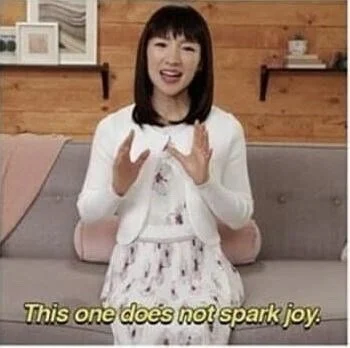
It does not…spark…joy.
Looking back at the excruciating example above: As a writer I need to ask myself some questions about what is actually relevant, actually necessary.
Do I need to describe the colour, grain and wood of the study desks? No.
Do I need to explain what fabric the chair covers are made of? Absolutely not.
Must I go into such mindless details about the stained-glass windows, or the dimensions of the room, or every damn book on the damn shelves? Hell no…please don’t.
Think of the larger context. The book is set in a stately home, a big old rambling house. The reader will already know what a library in such a place looks like. Catalogue of references, remember? There is no need for me to describe in detail the doors as they enter (in fact there’s no need to describe the doors at all).
The book at this point has already set the larger context of the old mansion. Not one reader, when told ‘they entered the library’ is going to be mistakenly picturing the doors as two flimsy plywood things, with a hole punched in them by some teenager called Kyle after one too many Monster energy drinks. They’re already going to be picturing big ole heavy-ass mansion doors.
Will they picture them exactly as I see them? With the decorations and fittings? Nope. Will they picture their own version? Absolutely, and it’s not only just as fine a vision, but just as appropriate and valid for them to do so.
So use your reader’s preconceptions and their own frame of reference, as well as the wider context you’ve already established, and paint an impression of the room instead. If there are things you really want them to see, that’s fine. I want people to know about the marble floor (they might picture wood otherwise, and that’s not what I want). I want them to know about the stained glass in the windows, because it sets a particular feel that isn’t necessarily in everyone’s immediate mental image if I say: ‘library in old house’. And I want to mention the lectern, because that’s relevant to the plot at this point.
So with this in mind, everything else can be background noise. Broad strokes. Here’s a second example, and I’ll explain after it why it’s better but still not ideal:
Robin threw open the heavy doors to the library, revealing a huge room with floor to ceiling bookcases all around. A wide expanse of marble floor stretched away before them, deep green and shot through with veins of white, polished to a high mirror shine. Before them, at the far end of the room, a raised area scattered with study desks and deep windowsills piled with tasselled cushioned lay, and the high arched windows, which stood either side of a sweeping staircase leading to the shadowy upper levels were filled with stained glass, depicting fantastic creatures, unicorns and gryphons. At the foot of the stairs, an ornate lectern stood alone, seemingly waiting patiently for any of the countless old books cramming every nook of the high shelves.
“Well,” Robin said, “It has to be here somewhere”.
While this is…to my tastes at least…much better, and less likely to send me into a drowsy coma and less likely to claw my own eyes out, it still by no means ‘sparks joy’ (to coin a Kondo phrase).
Even though now I’ve allowed the reader the basic courtesy of knowing themselves what an old library in a spooky old house looks like instead of leading them by the hand; even though I’ve made sure to add my impressionist flicks of the brush to impart the specific details I want to, just enough to distinguish MY library in a spooky old house from the next, it’s still horribly, horribly static.
How I would like to remedy this is to remove the utter stagnation of standing in the doorway with the reader, holding their hand tightly in mine while my characters patiently wait, tapping their feet, and casting the ‘camera’ of my eye around the room before I allow anything to actually happen in it. Doing so doesn’t get the train moving along its tracks again. People are still slouching in their carriages, glancing distractedly at Candy Crush and waiting impatiently for something to happen. Mixing forward movement in the plot however, and breaking up description with both character action and character voice is by FAR what I prefer. If I can manage to flick the paintbrush a couple of times to say ‘spooky old library’ and then get on with things, and instead use my characters and what they do to illustrate the details I want to, it helps to remove the intrusive ‘author telling you things’ voice, keeps you far closer to the characters, and far more immersed in the journey.
This last example below does this, and while it’s still far from perfect writing, it’s something I would consider at least good enough for a first draft:
Robin threw open the heavy doors to Erlking’s ancient library, blinking in the light.
“Well, it has to be here somewhere,” he said.
Karya entered at his side, craning her neck and turning in a large circle as they entered the quiet room, taking in the enormity of the shelving around them, crammed solid right to the ceiling with books and maps.
“And where, exactly would you suggest we start?” she sighed. “Have you seen how many books are at Erlking? Why does one house even need such a collection? It’s a little ridiculous. Surely no-one’s ever read all of these?”
Robin looked around helplessly. He had to agree. Even for a place like Erlking, the library was grand. Dark polished wood shone in the soft sunlight quietly falling through the far windows. Silence and stillness reigned.
“There are study tables up here, look,” Robin pointed out, sounding hopeful as he made his way across the deep green marble floor, glancing down to see his own reflection in its polished surface. “We need a plan of action.”
He hopped up a set of shallow steps and stopped before one of the two towering stained-glass windows. “I’ll set up camp here, by the unicorn window,” he said, nodding with his own decisiveness. “You grab a desk over under the…um..muscular-eagle-thing in the other window. We can divide and conquer.”
“It’s a Gryphon, you idiot,” Karya smirked. She pointed upwards. “And what about the second storey? And the third? We could be here all day.” She shrugged. “Maybe there’s some kind of index. That’s a library thing, right?”
As Robin fiddled experimentally with a desk lamp on one of the tables, the girl wandered slowly across to the foot of the sweeping staircase, running a hand over a large and ornate lectern which stood there empty.
“Come and look at this,” she suggested, her voice quiet and thoughtful. “I think I have an idea how things work in here.”
Again, this revision is not perfect, but compared to the first and second, it has movement, voice, action, just enough description to paint an idea, and reading it, I don’t feel like I’m being lectured to death by a flowery writer (if you’ve read my Changeling series, you already know why Karya is correct about the lectern being useful in finding the right book, but that’s another matter entirely).

The point is, in this last example, the train is moving. You can still get your description in there, but instead of drowning your reader in it, you can actually make the description have a purpose. You can use it to illustrate your characters, to hint at their personalities and feelings. I still got to mention the stained-glass window, but this time around we also learn that Robin is more than a little clueless about mythical beasts, and that Karya is far better versed. We still get to describe the scale of the room, but we use it to show Karya’s matter-of-fact personality at being daunted by their task, contrasted with Robin’s characteristic stubborn optimism that it can be done, as long as they are organised.
I don’t like description for description’s sake, but if you can use it not only to paint your scene for your readers, but as a tool to also paint your characters, that’s a good start in my book.
In second or third drafts, I would likely refine this a lot, as well as making sure to introduce more senses that just the visual. Atmosphere, as we covered last time, comes from all your senses, and I could easily add in mentions about old book smell, and furniture polish, or touch on the warmth of the sunlight through the window, or the coolness of the marble underfoot. But for every description I add in, further edits would likely see me take another out. In our train metaphor, too much of even a good thing is still leaves on the tracks.
I mentioned that I want to cover the Kondo ‘less-is-more’ in dialogue and conversation as well, but I have decided to do this next week, as it’s a whole other conversation, and it’s already getting late.
Your friend left the party already, and almost all of the nibbles are gone. Feel free to take some with you in a doggy bag if you like, if you thought they were tasty. I’ll call you an uber.